Commercial HVAC Servicing: Quick Answer
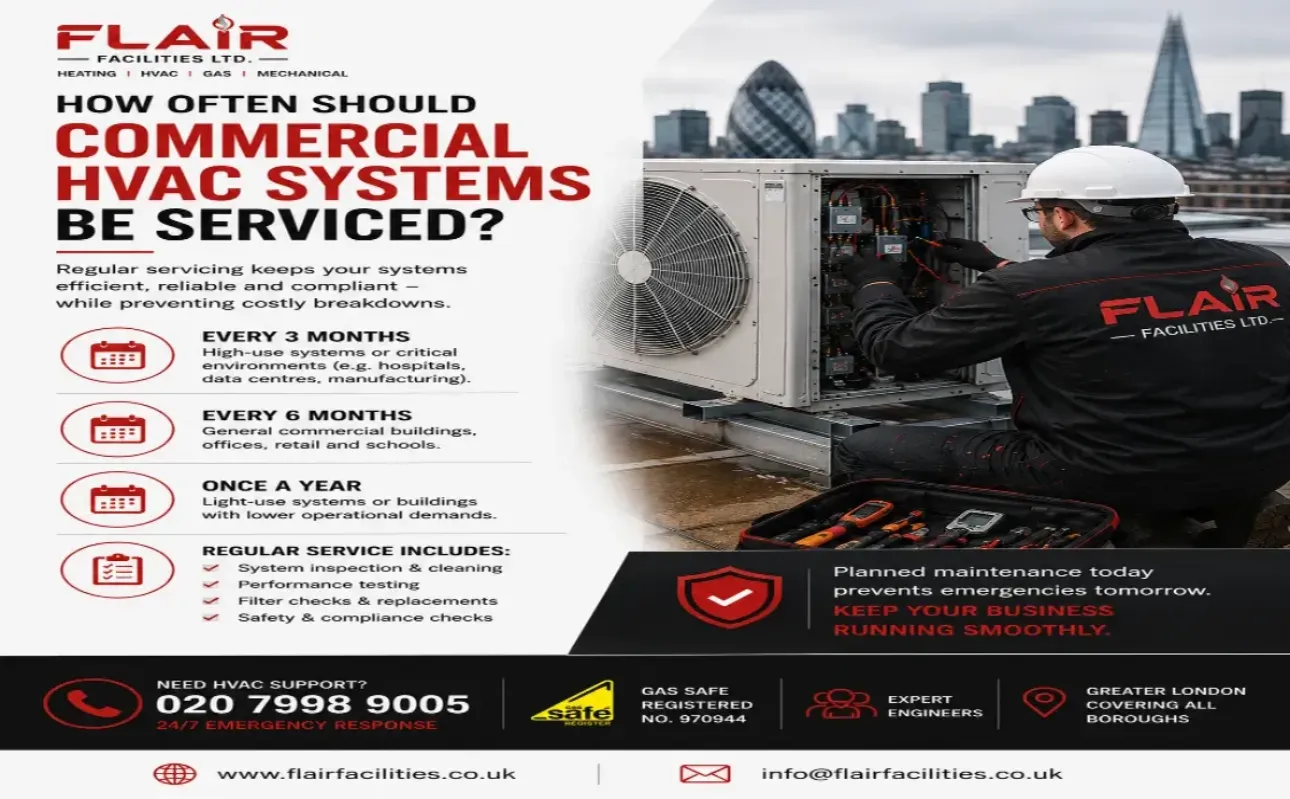
Commercial HVAC systems should normally receive a professional service at least once a year. However, annual servicing is often only the minimum for busy, high-occupancy, safety-critical, or continuously operating commercial buildings. Offices, hospitals, hotels, schools, warehouses, retail sites, manufacturing facilities, and leisure centres may need quarterly, bi-annual, or monthly inspections under a tailored Planned Preventative Maintenance programme.
The right servicing frequency depends on the equipment, operating hours, occupancy, manufacturer guidance, condition of the system, and building use. Regular commercial HVAC maintenance helps reduce unexpected breakdowns, improve energy efficiency, extend equipment life, maintain indoor comfort, and support safer building operation.
Flair Facilities Ltd provides commercial HVAC maintenance, heating, ventilation, cooling, plant room, boiler, pump, controls, and PPM support across Greater London. Flair’s PPM service includes scheduled inspections, servicing, testing, and repairs designed to identify faults before they become costly failures.flairfacilities.co
Why Regular Commercial HVAC Servicing Matters
Commercial HVAC systems work harder than most domestic systems. They often serve multiple floors, zones, tenants, operating hours, and different comfort requirements within one building. A typical system may include boilers, air conditioning units, air handling units, ventilation plant, pumps, valves, controls, sensors, heat exchangers, and Building Management Systems.
Without regular servicing, minor issues can develop into more expensive repairs, reduced efficiency, indoor comfort complaints, or complete equipment failure. A poorly maintained system may also run longer than necessary, use more energy, struggle to maintain set temperatures, or cause avoidable disruption during periods of peak heating or cooling demand.
Routine servicing can help to:
- Improve heating and cooling performance.
- Reduce unexpected equipment failures.
- Lower energy consumption.
- Improve airflow and indoor comfort.
- Support better indoor air quality.
- Extend equipment lifespan.
- Protect business continuity.
- Reduce long-term reactive maintenance costs.
- Support manufacturer maintenance recommendations.
- Improve records for facilities management and planned budgeting.
The HSE advises that workplaces with mechanical ventilation systems should ensure those systems are maintained in line with manufacturers’ instructions, and that recirculated air is appropriately filtered with fresh air added before it is reintroduced into the workplace.hse.gov
Recommended Commercial HVAC Service Frequency
The exact schedule should be based on a site-specific assessment. The table below provides a practical starting point for London commercial properties.
| Equipment or system | Typical recommended frequency | Why it matters |
| Commercial HVAC systems | At least annually; quarterly inspections for high-use sites | Helps identify faults before they affect comfort or operations |
| Commercial boilers | At least annually, subject to manufacturer and system requirements | Supports safe, efficient, and reliable heating |
| Air conditioning systems | Annually, ideally before peak cooling demand | Helps maintain cooling output and identify developing faults |
| Air Handling Units (AHUs) | Every 3–6 months, depending on use and air quality demands | Supports airflow, filtration, ventilation, and indoor air quality |
| Ventilation systems | Every 6–12 months, or more frequently where usage requires | Helps maintain suitable airflow and system condition |
| Heat pumps | At least annually | Supports efficiency, heating/cooling performance, and reliability |
| Building Management Systems (BMS) | Regular checks throughout the year | Ensures schedules, zoning, alarms, controls, and monitoring work correctly |
| Pumps and pressurisation units | During scheduled PPM visits | Helps protect circulation, pressure stability, and heating/cooling distribution |
| Filters | Based on condition, operating hours, and pressure drop | Helps maintain airflow and avoids strain on fans and equipment |
CIBSE guidance notes that planned preventative maintenance should reduce the risk of equipment breakdown or loss of performance. It can be time-based or condition-based, and the frequency should be reviewed where monitoring indicates that a change is necessary.cibse+1
What Determines How Often HVAC Equipment Needs Servicing?
Building occupancy and operating hours
A building operating long hours, seven days a week, is likely to place more demand on its heating, cooling, and ventilation systems than a lightly occupied office. Hotels, hospitals, leisure centres, retail sites, manufacturing facilities, and care environments may need more frequent checks.
Equipment type and age
Older systems, heavily used boilers, ageing pumps, legacy BMS controls, and equipment with a recurring fault history may require closer attention. Newer equipment should still be serviced in accordance with manufacturer guidance and warranty requirements.
Environmental conditions
Dust, pollution, high humidity, grease, industrial processes, kitchen extracts, construction activity, and high footfall can all affect filters, coils, fans, ventilation systems, and airflow performance.
Building use and criticality
A temporary comfort issue in a low-occupancy office may be manageable for a short period. In contrast, HVAC issues in healthcare environments, care homes, laboratories, IT rooms, food-service areas, education premises, or production facilities can have a greater operational impact.
Manufacturer guidance
Equipment manufacturers often provide maintenance guidance for safe operation, warranty protection, and performance. A professional contractor can help translate that guidance into a practical maintenance schedule for your site.
What Happens During a Commercial HVAC Service?
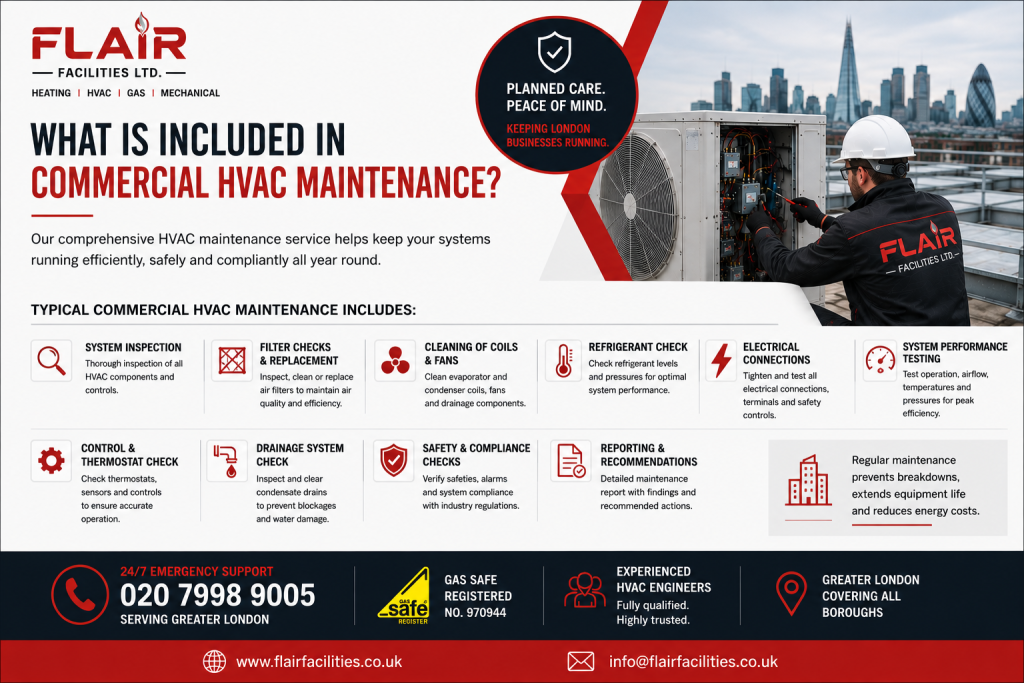
A professional commercial HVAC service is designed to assess condition, performance, safety, controls, and developing faults. The exact tasks depend on the equipment and agreed maintenance scope.
Typical activities may include:
- Visual inspection of equipment and associated plant.
- Cleaning or reviewing filters, coils, and accessible components.
- Checking electrical connections and controls.
- Inspecting motors, fans, belts, bearings, and dampers.
- Testing heating and cooling performance.
- Verifying thermostat, sensor, and control operation.
- Inspecting refrigerant-related components where applicable.
- Checking pumps, valves, pressure levels, and circulation.
- Reviewing Building Management System controls and schedules.
- Inspecting plant room equipment.
- Identifying worn, damaged, or inefficient components.
- Recording findings and making practical recommendations.
The goal is not simply to “tick a box”. Effective servicing helps identify developing problems before they create costly downtime, equipment damage, or operational disruption.
Signs Your Commercial HVAC System Needs Attention
Even with a maintenance plan in place, facilities teams should act quickly when the following warning signs appear:
- Uneven temperatures across the building.
- Poor airflow or rooms that feel stuffy.
- Unusual noises from boilers, pumps, AHUs, fans, or air conditioning units.
- Higher-than-expected energy bills.
- Persistent odours.
- Frequent cycling, tripping, or boiler lockouts.
- Water leaks, condensation, or pressure loss.
- Inconsistent heating or cooling.
- Repeated equipment alarms.
- Poor occupant comfort or increased complaints.
- Systems that fail to respond to BMS schedules or controls.
- Reduced ventilation performance.
Prompt assessment can help prevent a smaller fault from becoming an emergency repair or a larger replacement project.
The Benefits of Planned Preventative Maintenance
A proactive approach to HVAC reliability
Planned Preventative Maintenance, commonly known as PPM, is a structured maintenance programme that schedules inspections, servicing, testing, adjustments, and necessary minor repairs before faults become costly failures.
Flair Facilities describes commercial PPM as a proactive strategy covering commercial heating, mechanical services, HVAC systems, gas installations, water pressure systems, and plant rooms across Greater London.flairfacilities.co
Benefits of a tailored PPM programme
A commercial PPM programme can help businesses:
- Detect faults earlier.
- Improve heating, cooling, and ventilation reliability.
- Reduce emergency repair requirements.
- Extend asset lifespan.
- Improve energy performance.
- Support better maintenance budgeting.
- Maintain more comfortable indoor environments.
- Improve plant condition visibility.
- Reduce avoidable disruption to tenants, staff, customers, and visitors.
- Build a clearer maintenance history for key assets.
For facilities with continuous operations or critical environmental requirements, PPM provides a more controlled and predictable approach than reactive maintenance alone.
Which Buildings Benefit From More Frequent HVAC Servicing?
Commercial HVAC maintenance is particularly important for:
- Office buildings and multi-tenanted properties.
- Hospitals, clinics, and healthcare facilities.
- Hotels and hospitality venues.
- Care homes and assisted-living environments.
- Schools, colleges, and universities.
- Warehouses and logistics centres.
- Manufacturing and industrial facilities.
- Retail stores and shopping centres.
- Leisure centres, gyms, and sports facilities.
- Commercial kitchens and food-service environments.
- Public buildings and local authority premises.
- Multi-site property portfolios.
Flair Facilities supports commercial clients across these types of properties with heating, HVAC, plant maintenance, PPM, boiler servicing, and mechanical engineering services.flairfacilities.co+1
Choosing the Right Commercial HVAC Contractor
Regular servicing is only as effective as the maintenance strategy and engineering expertise behind it. When choosing a contractor, look for a provider that understands commercial systems, responds clearly, documents findings, and can support both scheduled maintenance and emergency faults.
Consider the following:
- Proven commercial HVAC and mechanical services experience.
- Gas Safe registration where gas work is required.
- A tailored PPM programme rather than a one-size-fits-all checklist.
- Emergency response capability.
- Experience with boilers, AHUs, ventilation, pumps, controls, BMS systems, and plant rooms.
- Clear reports and practical recommendations.
- Understanding of your sector and operational constraints.
- Transparent quotations and communication.
- The ability to support multiple sites where required.
Working with one trusted contractor can simplify maintenance management, create continuity of knowledge, and support more reliable long-term building performance.
Why Choose Flair Facilities Ltd?
Flair Facilities Ltd provides commercial HVAC maintenance and mechanical engineering support across Greater London. The company publishes commercial HVAC, heating, plant maintenance, gas engineering, PPM, boiler servicing, and emergency repair services for commercial and industrial clients.flairfacilities.co+1
Our experienced engineers support businesses with:
- Commercial HVAC Contractors
- Commercial Heating Services Greater London
- Commercial Planned Preventative Maintenance (PPM)
- Commercial Plant Maintenance and Compliance
- Commercial Boiler Installation
- Commercial Boiler Repair and Maintenance
- Commercial HVAC and Cooling Services
- Air Handling Unit Services
- Building Management Systems
- Commercial Pump Services
Whether you operate one commercial property or manage a multi-site portfolio, Flair Facilities can help develop a maintenance approach designed around equipment condition, operational demand, risk, compliance needs, and budget.
Key Takeaways
- Commercial HVAC systems should generally be serviced at least once every year.
- High-use, high-occupancy, or critical commercial buildings often benefit from quarterly or bi-annual inspections.
- Commercial boilers should normally receive at least annual servicing, subject to manufacturer guidance and site requirements.
- AHUs, ventilation systems, pumps, filters, BMS controls, and air conditioning equipment may need more frequent checks.
- Planned Preventative Maintenance helps reduce breakdowns, control costs, improve energy efficiency, and extend equipment lifespan.
- A tailored maintenance schedule is more effective than relying solely on reactive repairs.
- Experienced commercial HVAC contractors can support safer, more reliable, and more efficient building operation.
Frequently Asked Questions
How often should commercial HVAC systems be serviced?
Most commercial HVAC systems should be professionally serviced at least once a year. Higher-use or critical sites often require quarterly, bi-annual, or monthly inspections under a tailored PPM programme.
Is annual servicing enough for a commercial HVAC system?
Annual servicing may be enough for lower-use systems in stable environments. However, buildings with long operating hours, high occupancy, sensitive environments, or complex equipment often need more frequent maintenance.
How often should commercial boilers be serviced?
Commercial boilers should generally be serviced at least annually, subject to manufacturer instructions, equipment condition, fuel type, system demand, and operational requirements.
How often should air conditioning systems be serviced?
Commercial air conditioning systems should normally be serviced at least once a year, preferably before periods of peak cooling demand. Higher-use systems may benefit from additional inspections.
How often should AHUs be serviced?
Air Handling Units often require servicing every three to six months, depending on operating hours, filters, air quality requirements, environmental conditions, and system type.
How often should ventilation systems be checked?
Ventilation systems should usually be inspected every six to twelve months, although more frequent checks may be needed where systems operate continuously or serve high-occupancy, industrial, healthcare, or kitchen environments.
What is included in commercial HVAC servicing?
Typical work includes equipment inspections, cleaning filters and coils, checking fans and motors, reviewing controls, testing heating and cooling performance, checking pumps and valves, and identifying worn components.
What is Planned Preventative Maintenance?
PPM is a proactive programme of scheduled inspections, servicing, testing, and minor repairs designed to identify faults before they become significant failures.flairfacilities.co
Can PPM reduce emergency HVAC repairs?
Yes. Regular inspection and servicing can identify wear, control issues, pressure problems, poor airflow, blocked filters, leaks, and component deterioration before they create a breakdown.
What are signs that HVAC equipment needs urgent attention?
Warning signs include poor airflow, uneven temperatures, unusual noises, water leaks, pressure loss, persistent odours, alarms, system trips, high energy use, and repeated boiler lockouts.
Does HVAC servicing improve energy efficiency?
Yes. Clean filters, properly functioning controls, well-maintained fans, pumps, coils, and boilers can help equipment run more efficiently and avoid unnecessary energy waste.
Do commercial HVAC systems need maintenance even if they appear to be working?
Yes. Many faults develop gradually and may not be obvious until system performance deteriorates or a component fails. Preventative checks can identify these issues earlier.
Can poor HVAC maintenance affect indoor air quality?
Yes. Poor airflow, blocked filters, dirty components, inadequate fresh-air provision, and neglected ventilation equipment can all affect indoor air quality. HSE advises maintaining mechanical ventilation systems according to manufacturer instructions.hse.gov
What buildings need the most frequent HVAC servicing?
Hospitals, hotels, care homes, schools, universities, warehouses, manufacturing sites, retail premises, leisure centres, commercial kitchens, and large office buildings often benefit from more frequent servicing.
Do you provide commercial boiler servicing in London?
Yes. Flair Facilities supports commercial boiler servicing, repairs, installation, heating maintenance, plant room support, PPM, and emergency commercial heating services across Greater London.flairfacilities.co
Can you maintain BMS controls as part of HVAC servicing?
Yes. BMS checks can be included within a wider maintenance strategy to review schedules, alarms, setpoints, sensors, zones, and HVAC controls.
Do you offer multi-site commercial HVAC maintenance?
Yes. Flair Facilities can support businesses, managing agents, facilities management companies, and property portfolios with structured PPM and reactive maintenance support.
Can HVAC servicing extend equipment lifespan?
Yes. Routine servicing can reduce component stress, identify wear early, improve performance, and help equipment remain operational for longer.
What happens if I only use emergency HVAC repairs?
Reactive-only maintenance can lead to more unexpected downtime, higher emergency costs, reduced efficiency, avoidable equipment damage, and less predictable maintenance budgeting.
How do I arrange commercial HVAC servicing with Flair Facilities?
Call 020 7998 9005, email [email protected], or visit the Flair Facilities website to discuss your building, equipment, and maintenance requirements.
Related Commercial Engineering Services
Flair Facilities Ltd provides complete commercial heating and mechanical support, from commercial boiler installation and commercial boiler repair and maintenance to planned preventative maintenance and commercial plant maintenance and compliance.
Our commercial HVAC contractors support commercial heat pumps, air handling units, Building Management Systems, and commercial pump services.
Recognised External Resources
For additional guidance, use these recognised industry resources:
- Gas Safe Register — Check registered gas businesses and engineers.
- Health and Safety Executive — Workplace health, safety, and ventilation guidance.
- CIBSE — Building services engineering and maintenance guidance.
- BESA — Building engineering services information and industry best practice.
Arrange Commercial HVAC Servicing in London
If you need a reliable commercial HVAC servicing programme, boiler maintenance, ventilation inspection, AHU maintenance, plant room support, or tailored Planned Preventative Maintenance contract, Flair Facilities Ltd is ready to help.
Phone: 020 7998 9005
Email: [email protected]
Website: Flair Facilities Ltd
Request support: Contact Flair Facilities