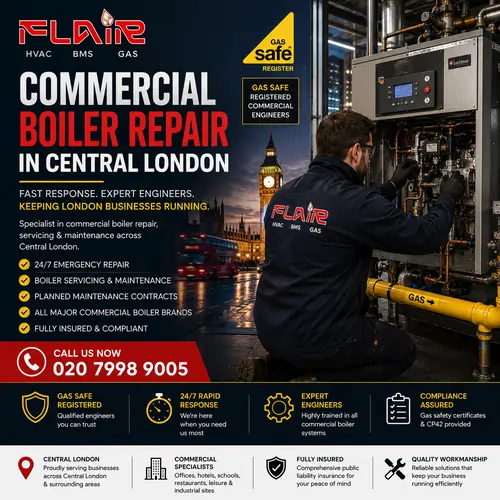
Commercial boiler repair in Central London by Gas Safe experts. Prevent breakdowns, stay compliant and protect heating and hot water for commercial buildings.
Introduction
Commercial boilers are the backbone of heating and hot water in Central London’s offices, hotels, hospitals, schools and mixed‑use developments. When they fail, the impact is immediate: cold buildings, unhappy occupants, and potential safety and compliance issues.
For facilities managers, commercial boiler repair isn’t just about getting the heat back on. It’s about managing risk, protecting budgets, staying compliant with UK gas safety regulations, and planning long‑term reliability across the whole plant room.
This guide explains what every facility manager should know about commercial boiler repair in Central London, how to choose the right partner, and how to turn reactive fixes into proactive performance and decarbonisation gains.
Quick Answer
Commercial boiler repair in Central London is the specialist process of diagnosing, fixing and optimising commercial gas and steam boiler systems serving larger buildings, carried out by Gas Safe registered commercial engineers to restore safe, efficient operation and maintain compliance. For facilities managers, this means rapid response when faults occur, structured planned maintenance, and clear documentation of safety checks and remedial work.
Key Takeaways
- Commercial boiler failures are high‑impact events that can disrupt entire buildings, especially in winter or at peak occupancy.
- Facilities managers must use Gas Safe registered commercial engineers for any work on commercial gas boilers and associated plant.
- Many serious breakdowns can be prevented with planned preventative maintenance (PPM) across boilers, pumps, controls and pipework.
- Compliance with UK gas safety and ventilation requirements is essential, not optional.
- Working with a specialist such as Flair Facilities Ltd allows you to combine emergency response, PPM, energy‑efficiency improvements and decarbonisation into one coherent strategy.
1. What “Commercial Boiler Repair” Really Means in Central London
Quick Definition
Commercial boiler repair is the end‑to‑end process of fault‑finding, rectification and optimisation on boiler plant serving commercial and industrial buildings. It covers the boiler itself and the surrounding systems that enable it to work safely and efficiently.
Beyond “Fixing a Box”
In Central London, a commercial boiler rarely operates alone. It usually sits in a plant room alongside:
- Multiple boilers in cascade or lead/lag configuration
- Circulation pumps and booster sets
- Pressurisation units and expansion vessels
- Calorifiers, heat exchangers and distribution pipework
- Flues, ventilation ducts and combustion air intakes
- Controls, safety devices and building management systems (BMS)
A proper repair visit should consider how all of these work together. A burner fault may be the symptom; the underlying cause may be poor flow, failed pumps, incorrect controls, blocked strainers or untreated water. A “reset and hope for the best” approach is not enough for commercial plant.
Typical Repair Visit – What You Should Expect
When you call a commercial specialist such as Flair Facilities Ltd, a well‑structured visit should include:
- Initial brief from the facilities team on symptoms, timing and impact
- Visual inspection of boilers, burners, flues, gas pipework and ventilation
- Checks on water pressure, flow, and operation of pumps and pressurisation units
- Diagnostic tests on controls, sensors, thermostats and safety devices
- Safe isolation of suspect components, followed by repair or replacement
- Functional and safety checks before returning the boiler to service
- Clear written report with findings, remedial works completed, and further recommendations
As a facility manager, insist on that level of thoroughness. It’s the difference between a temporary fix and a genuinely reliable system.
2. The Hidden Risks of Ignoring Boiler Faults
Operational Risk
Small faults become big problems if they are ignored:
- Short cycling and frequent lockouts can escalate into full failure
- Poor circulation can lead to cold spots, trapped air and noisy systems
- Minor leaks can damage plant rooms, ceilings and finishes
- Unreliable hot water can hit catering, hygiene and guest experience
These risks are particularly acute in Central London, where occupant expectations and business continuity requirements are high. A hotel without hot water, a hospital with cold wards or an office with failed heating can quickly turn into a reputational issue.
Safety and Compliance Risk
Commercial boilers deal with combustion, gas, pressure and hot water. Unresolved faults can increase the risk of:
- Gas leaks from faulty valves, pipework or joints
- Poor combustion due to blocked burners or inadequate air
- Products of combustion entering occupied spaces if flues or ventilation are compromised
- Over‑pressurisation if safety devices fail
UK employers and dutyholders have clear responsibilities under gas safety regulations. If your plant is not properly inspected and repaired, you may breach those duties. That’s not simply a technical problem: it can become a legal and insurance issue.
Financial and Environmental Risk
Faulty boilers are rarely efficient. They often:
- Consume more gas to deliver the same output
- Increase wear and tear on pumps and pipework
- Reduce the lifespan of major assets
- Raise your carbon footprint
Addressing faults quickly and properly protects both operating budgets and decarbonisation plans.
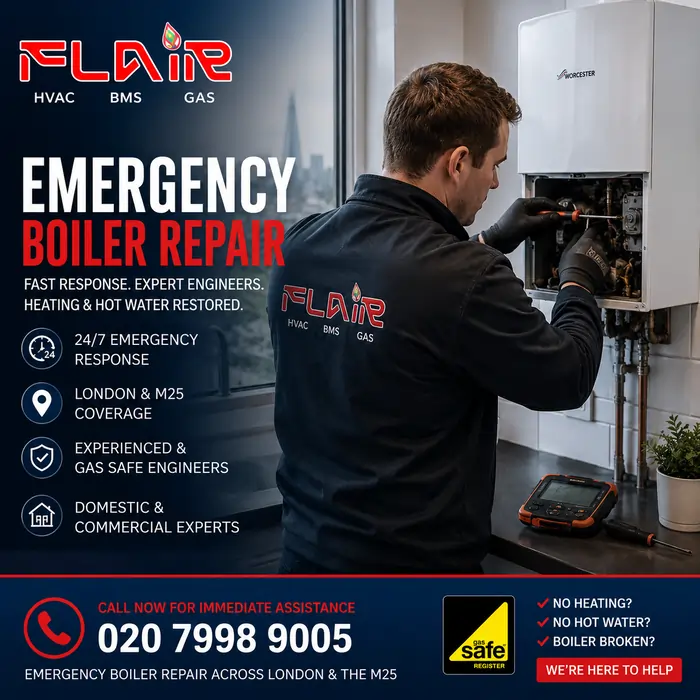
3. 10 Common Commercial Boiler Problems Facilities Managers Notice First
Facilities managers and helpdesk teams usually spot symptoms before engineers do. Common early warning signs include:
- Boiler lockouts and repeated fault codes
Frequent resets indicate an underlying issue, not just “one bad day”. - Inconsistent heating across floors or zones
Some areas hot, others cold; often linked to flow issues, air in the system or control problems. - Slow hot water recovery
Cylinders or calorifiers taking longer to reach temperature, especially at peak times. - Unexpected noises
Knocking, banging, whistling or humming from boilers, pumps or pipework can indicate air, cavitation, poor alignment or failing components. - Visible leaks or drips
From valves, unions, strainers, pumps or the boiler casing itself. - Fluctuating system pressure
Pressure dropping or rising abnormally, often pointing to expansion vessel or pressurisation unit issues. - Unusual smells
Combustion smells near boiler plant must be investigated immediately. - High gas consumption without obvious cause
Bills rising despite similar occupancy and weather, suggesting poor efficiency. - Frequent manual interventions
Operators constantly adjusting setpoints, resetting alarms or overriding BMS – a sign the system is not stable. - Repeated comfort complaints from occupants
Less technical but very real; when people complain regularly, it’s usually because the system is not performing.
Your role is to recognise these as early alerts and take action before a full breakdown.
4. How to Triage a Boiler Breakdown: A Manager’s Checklist
When the boiler plant fails, time is critical. A simple triage process helps you respond calmly and effectively.
Step 1: Assess the Impact
- Which buildings or zones have lost heating or hot water?
- Are critical services affected (clinical areas, kitchens, showers, vulnerable occupants)?
- Is there any immediate safety concern (smell of gas, visible damage, alarms)?
Capture this information clearly. It will guide prioritisation.
Step 2: Check Local Factors
Without attempting technical repair, quickly verify:
- Are relevant valves, isolators and breakers in the expected positions?
- Are BMS schedules and setpoints sensible (no unexpected “off” periods)?
- Are there obvious leaks, alarms or error codes visible on the plant or BMS?
This can rule out simple issues and provide engineers with valuable context.
Step 3: Escalate Internally
- Notify your FM lead or dutyholder according to your incident procedure.
- Log the event in your CAFM/helpdesk system with time, impact and observations.
- Confirm who will act as site contact for the attending engineers.
Step 4: Contact a 24/7 Commercial Specialist
For Central London sites, engage a provider that offers:
- 24/7 emergency response with commercial boiler experience
- Gas Safe registered engineers for commercial gas
- Knowledge of plant rooms, BMS and large‑scale HVAC
Flair Facilities Ltd, for example, provides dedicated commercial boiler and mechanical services across Greater London.
Step 5: Prepare Information for Engineers
Have the following ready:
- Site address, access instructions and security requirements
- Boiler manufacturer, model and approximate age (if known)
- Recent service history and any known recurring faults
- BMS vendor and whether controls have been adjusted recently
- Any restrictions (noise, access, working at height, permit‑to‑work)
The better the information, the faster the diagnosis.
5. Why You Must Use Gas Safe Registered Commercial Engineers
Domestic vs Commercial – Not the Same
Domestic gas engineers may be highly competent, but they are trained and registered for small‑scale appliances. Commercial boiler plant is different in several ways:
- Larger input ratings and more complex combustion systems
- Multiple boilers in cascade or modular configuration
- Integration with large distribution systems, fan coils, air handling units and process loads
- More stringent requirements around ventilation, flue design and plant room layout
You need engineers specifically registered and experienced in commercial gas work.
Legal and Insurance Considerations
Using appropriately qualified engineers is not just best practice; it’s part of your legal duties. If work is carried out by someone who is not correctly registered for commercial gas:
- You may be non‑compliant with gas safety regulations
- Insurance claims may be harder to pursue after an incident
- You increase the risk of unsafe installation or repair
Always request and check Gas Safe registration, including the categories relevant to your plant.
6. Understanding Your Plant Room: Boilers, Pumps, BMS and Pipewor
A commercial boiler depends on everything around it. Facilities managers benefit from a basic mental model of the plant.
Key Components
- Boilers and burners – generate hot water or steam
- Primary and secondary pumps – move water through the system
- Pressurisation units and expansion vessels – maintain safe system pressure
- Calorifiers and heat exchangers – transfer heat to domestic hot water or other circuits
- Pipework and valves – distribute heat and allow isolation and balancing
- Controls, sensors and safety devices – monitor temperatures, pressures and flows
- BMS – coordinates plant operation in response to demand, time and external conditions
A fault in any of these can present as a “boiler problem”. Engineers must consider the whole picture.
Why This Matters for Repairs
Understanding the plant room helps you:
- Give engineers better information
- Recognise when a wider system issue is at play
- Support recommendations for upgrades (e.g. variable speed pumps, control optimisation)
It also helps you communicate more effectively with non‑technical stakeholders who just “want the heat back on”.
7. Emergency Boiler Repair vs Planned Preventative Maintenance (PPM)
Two Complementary Strategies
You will always need emergency repair capacity. Boilers will fail at some point. But you can reduce the frequency and severity of failures by building a robust PPM strategy.
Emergency repair focuses on:
- Restoring operation as quickly as possible
- Minimising downtime for occupants
- Managing immediate safety concerns
PPM focuses on:
- Preventing breakdowns through regular servicing and inspections
- Cleaning and optimising combustion and heat transfer surfaces
- Checking and adjusting controls, valves and safety devices
- Identifying emerging issues before they cause outages
Comparison Table
| Aspect | Emergency Repair | Planned Preventative Maintenance (PPM) |
|---|---|---|
| Trigger | Failure or alarm | Scheduled service visits |
| Priority | Restore service fast | Prevent failures, optimise efficiency |
| Cost | Higher per incident, often out‑of‑hours | Predictable, lower lifecycle cost |
| Risk | Higher risk; reacting to problems | Lower risk; proactively managing plant |
| Best Provider | 24/7 commercial boiler specialist | Same specialist delivering structured maintenance plans |
For Central London estates, a combination of both is essential. The more mature your PPM regime, the less disruptive your emergency events will be.
8. Compliance Essentials: Gas Safety, CP42, Ventilation and Purging
Core Gas Safety Duties
Dutyholders must ensure that:
- Gas appliances and flues are maintained in a safe condition
- Gas work is only undertaken by Gas Safe registered engineers
- Adequate records of maintenance and inspection are kept
- Risks from gas leaks and products of combustion are controlled
For facilities managers, this means integrating compliance into everyday maintenance and repair activities, not treating it as a separate checklist.
Ventilation and Flues
Plant rooms must have adequate ventilation for safe combustion. Flues must be correctly designed, installed and maintained to carry combustion products safely away from the building.
Engineers should check:
- Air intakes and ventilation openings are clear and correctly sized
- Flue routes are intact, supported and free from obstruction
- Termination points are safe relative to windows, intakes and occupied areas
Faults in these areas can be dangerous even if the boiler itself appears to run.
CP42 and Industrial Gas Purging
Certain environments, such as commercial kitchens and industrial plant, have additional certification and purging requirements. While CP42 relates specifically to commercial catering, the underlying principle applies: gas installations must be commissioned, tested and maintained correctly.
Where plant or pipework is modified, purging and tightness testing must be carried out by competent engineers following recognised procedures. Facilities managers should expect clear documentation of these activities as part of repair and project work.
9. Energy Efficiency and Decarbonisation: Turning Repairs into Upgrades
From Repair to Performance Improvement
Every repair visit is an opportunity to:
- Update setpoints and control strategies for better efficiency
- Identify oversized or poorly matched equipment
- Assess whether combustion optimisation or boiler sequencing could reduce gas use
- Consider improvements to insulation, valves and pipework
Rather than just “fix and leave”, ask for efficiency observations as part of repair reports.
Boiler Plant and Net‑Zero Strategies
Boiler upgrades, hybrid systems and heat pumps are increasingly part of decarbonisation plans. Facilities managers can use repair and maintenance data to inform investment decisions:
- Frequent faults on older boilers may justify replacement
- High gas consumption may indicate the need for better controls or alternative technology
- Opportunities may exist to integrate boilers with low‑carbon heat sources
A provider that understands both traditional boiler plant and modern energy solutions can help bridge the gap between day‑to‑day operation and long‑term net‑zero goals.
10. How BMS and Controls Impact Boiler Reliability and Costs
BMS as the System “Brain”
The BMS decides when boilers should run, at what temperatures, in what sequence and under what conditions. Poor configuration or faulty sensors can produce:
- Excessive boiler cycling
- Running plant when there is no real demand
- Inadequate frost protection or setback strategies
- Conflicts between different control loops
Many “boiler problems” trace back to controls, not hardware.
Controls and Maintenance
PPM should include checks on:
- Sensor calibration and positioning
- Valve actuators and damper operation
- Time schedules and holiday settings
- Alarm setpoints and response processes
When repair visits occur, engineers should consider whether controls contributed to the fault and, if so, document this and recommend changes.
11. Best Practice PPM Strategy for Central London Estates
Build a Critical Asset Register
Start by mapping:
- All boilers and associated plant, with location and duty
- Age, capacity, manufacturer and service history
- Criticality to operations (clinical, hospitality, office, residential)
This enables prioritisation and risk‑based maintenance planning.
Define Service Frequencies
Typical PPM elements for commercial boilers include:
- Annual full service with combustion checks and cleaning
- Interim checks for heavily loaded or critical plant
- Regular pump, pressurisation and valve inspections
- Water treatment monitoring to protect boilers and pipework
- Periodic review of BMS strategies as occupancy patterns change
Integrate these into your CAFM system or maintenance calendar, with clear responsibilities and escalation routes.
Link PPM to Compliance and Reporting
Maintenance records should support:
- Gas safety compliance
- Insurance and warranty requirements
- Internal audits and governance
Repair and service reports should be detailed enough to demonstrate that risks are being actively managed.
12. Red Flags: When It’s Time to Consider Boiler Replacement
Not every boiler is worth repairing indefinitely. Red flags include:
- Age beyond typical economic life, combined with frequent faults
- Obsolete parts or limited manufacturer support
- Very poor efficiency compared to modern alternatives
- Plant room layouts that constrain safe or efficient operation
- Planned building changes that will significantly alter demand patterns
For facilities managers, the decision is both technical and commercial. An experienced engineering partner can help build a business case that balances capital costs, operating costs, risk and sustainability.
13. Working with Flair Facilities Ltd: What to Expect
Flair Facilities Ltd specialises in commercial mechanical engineering, including:
- Commercial boiler systems
- Steam boilers and steam distribution
- Commercial HVAC and air conditioning
- Warm air heating
- Plant rooms, pumps and pressurisation units
- Building Management Systems (BMS)
- Planned preventative maintenance and facilities maintenance
For Central London facilities managers, this means you can:
- Use one provider for emergency boiler repair and structured PPM
- Get comprehensive reports covering safety, performance and recommendations
- Access 24/7 emergency response with Gas Safe commercial engineers
- Explore energy‑efficiency and decarbonisation options alongside day‑to‑day repairs
You gain a partner who understands both the engineering details and the commercial realities of running buildings in a demanding urban environment.
14. Cost Drivers: What Really Affects the Price of Commercial Boiler Repairs
Repair costs vary widely. Key drivers include:
- Type and size of boiler – larger or specialist plant can be more complex to work on
- Nature of the fault – simple components vs major mechanical or controls issues
- Access and location – difficult plant rooms, restricted working hours or sensitive environments
- Availability of parts – lead times, manufacturer pricing and logistics
- Timing – out‑of‑hours and emergency callouts vs planned work
- Scope of checks – whether work includes wider system inspection, testing and reporting
Transparent providers will explain these factors upfront and provide clear quotes and options.
15. Practical Scenarios: Hotels, Offices, Healthcare and Education
Hotels
- High hot water demand for showers and kitchens
- Guest comfort and reputation tightly linked to boiler performance
- Need for rapid response and minimal disruption during business hours
Offices
- Comfort complaints impacting productivity
- Mixed use of fan coils, radiators and air handling units
- BMS complexity often a factor in faults and efficiency
Healthcare
- Critical temperature requirements for patient comfort and infection control
- More stringent risk and resilience expectations
- Often multiple boilers and redundant systems
Education
- High heating demand during term, lower during holidays
- Boilers often working hard at specific morning and evening peaks
- Budgets under pressure, making efficiency improvements attractive
Each sector has a different risk profile and operational context. Facilities managers should tailor repair and PPM strategies accordingly.
Frequently Asked Questions
- What qualifies as a commercial boiler?
A commercial boiler is designed to serve larger buildings or multiple units, with higher output and different installation standards than domestic boilers. It typically connects to extensive distribution systems and plant rooms. - How do I know if my boiler needs urgent repair?
If you have a boiler lockout, loss of heating or hot water, unusual smells, visible leaks or safety alarms, treat it as urgent and contact a commercial boiler specialist immediately. - Can a domestic gas engineer work on my commercial boiler?
Domestic gas engineers may be skilled, but they are not necessarily registered or experienced for commercial plant. You should use Gas Safe registered engineers qualified for commercial gas work. - How often should commercial boilers be serviced?
At least annually as a minimum, with more frequent checks for high‑load or critical systems. Your PPM plan should reflect building usage and risk. - What are the most common causes of breakdowns?
Lack of maintenance, poor water treatment, control issues, pump failures and ageing equipment are all frequent causes. - What should I do first if the boiler fails?
Assess the impact, check for obvious safety issues, log the event and contact your approved 24/7 commercial boiler partner. - What is the difference between a steam boiler and a standard heating boiler?
Steam boilers generate steam for process or heating, often at higher pressures, while standard boilers generate hot water for space heating and domestic use. - How does a BMS affect boiler performance?
The BMS controls when boilers run, at what temperature and under what conditions. Poor programming or faults can cause inefficiency and instability. - What gas safety obligations apply to facilities managers?
Facilities managers must ensure gas appliances and flues are maintained safely, gas work is done by registered engineers, and records are kept. - What is CP42 and when is it relevant?
CP42 is a gas safety certificate associated with commercial catering installations. It matters where kitchens and associated gas equipment form part of your estate. - Can I improve efficiency without replacing boilers?
Yes. Combustion optimisation, control tuning, insulation improvements and pump upgrades can all yield savings. - When should I consider boiler replacement?
When the boiler is old, unreliable, inefficient, hard to support or no longer suited to building demand. - Do commercial boiler repairs support decarbonisation?
They can. Data from repairs and maintenance helps identify opportunities for upgrades, hybrid systems and low‑carbon solutions. - What information should I give engineers when I call?
Site details, impact of the fault, boiler type, recent history, BMS details and access requirements. - Do you cover sites beyond Central London?
Many commercial specialists, including Flair Facilities Ltd, support wider Greater London and surrounding areas. Check service area pages or ask when you enquire. - How can I reduce the risk of winter failures?
Ensure boilers are serviced before the heating season, address known issues, review BMS schedules and verify plant room readiness. - What role does water treatment play?
Proper water treatment protects boilers, pipework and heat exchangers from corrosion and scale, reducing breakdowns and maintaining efficiency. - Do I need documented reports for every repair?
Yes. Reports support compliance, insurance, internal audit and future decision‑making. - Can PPM and repairs be combined with other building works?
Often they can, especially when plant rooms are being modified or energy projects are underway. Coordination reduces disruption. - How do I choose the right commercial boiler partner?
Look for Gas Safe commercial registration, proven experience with similar sites, 24/7 capability, strong reporting and a proactive approach to efficiency and compliance.
If your commercial boiler plant in Central London is showing faults, running inefficiently or has already failed, now is the time to act.
Flair Facilities Ltd provides:
- Gas Safe registered commercial boiler engineers
- 24/7 emergency response across Central and Greater London
- Planned preventative maintenance for boilers, HVAC, pumps and plant rooms
- Compliance‑focused inspections and reporting
- Energy‑efficiency and decarbonisation support for modern estates
To arrange an inspection, emergency repair or discuss a maintenance plan:
- Call 020 7998 9005
- Email [email protected]
Take control of your boiler plant before the next fault takes control of your building.